The Power of Presence
Part Six: The Therapist’s Nervous System and the Healing Environment
A 12-Week Clinical Self-Study on Therapeutic Touch.
Over the past five parts, this study has taken me from listening to the body, to witnessing release, exploring breath, surrendering control, and beginning to recognize the physical patterns through which we protect ourselves. Now the inquiry turns toward something I had not expected: the person providing the touch. What happens when the practitioner's own nervous system becomes part of the healing environment?
Co-Regulation
That was the word I had been missing back in Week Three, when I lay on the table trying to make sense of why I could feel something in another person's state before either of us had said anything out loud. I did not have language for it then. I just knew something in the room had shifted, and my body had registered it before my mind found words.
It turns out science has begun giving parts of that experience a language. Research on interpersonal physiology suggests that physiological activity between people can become coordinated or interdependent during interaction, and emerging clinical research has explored how physiological synchronization may relate to processes like empathy and the therapeutic alliance. [1, 2]
That does not mean one person magically regulates another. It does not mean we can accurately read someone's thoughts or emotions through touch, and it certainly does not mean every sensation we feel is objective evidence about another person. For me, the concept offers something more grounded: we do not enter a treatment room as isolated nervous systems. The patient brings something, the practitioner brings something, the room brings something, and the interaction becomes something of its own.
When I think back to Week Three, I no longer need to decide whether I was imagining the shift. I can simply treat the sensation as information from my own system. My body responded to something, and that was enough to make me curious.
What I Noticed From the Table
Massage is often discussed through the language of technique: anatomy, pressure, modality, treatment planning, contraindications, clinical goals. All of that matters.
But becoming the recipient forced me to notice something I could never fully understand from behind the table. The person behind the hands matters too. Not because the practitioner holds some special power over another person's healing, but because every treatment takes place inside a human relationship, in an environment the nervous system is constantly responding to.
From the practitioner side, I had spent years thinking about pressure, tissue, positioning, and goals. From the table, I noticed something subtler.
I could feel the difference between touch that felt intentional and connected and touch that felt slightly hesitant. I noticed changes in rhythm, moments when a practitioner seemed fully settled into the work and moments when something felt less fluid.
These were not criticisms. They were observations from the receiving side of the therapeutic relationship.
As a recipient, I was not consciously analyzing every movement. My body was simply responding to sound, movement, pressure, rhythm, proximity, facial expression, and touch.
Some of that information arrived through conscious awareness, and some seemed to arrive first as sensation. This is where interoception becomes useful. It is not simply the ability to notice a feeling; it encompasses the processes involved in sensing, interpreting, integrating, and regulating information about the body's internal state. [3] Sometimes the mind receives the information first. Sometimes the body does. That does not mean the body is always right. It means the sensation is worth noticing.
Silence, Communication, and Presence
I have always preferred silence during massage. Conversation pulls my attention outward; silence lets it move inward. But this study reminded me that what helps me feel safe may not help someone else. Some people relax through conversation, some through quiet. Some need reassurance, some need information, and some need to know exactly what is happening before they can let go. There is no single doorway into relaxation. The skill is recognizing which doorway a particular person needs.
Research on the therapeutic relationship in massage therapy has identified communication, safety, comfort, boundaries, contact, and empathy as meaningful components of the encounter. [4] That changed how I think about presence. Presence is not simply being quiet. It is paying attention: noticing what the person in front of you is communicating, verbally and nonverbally, and responding without forcing the experience into your own preferred way of working. The treatment does not begin when the hands make contact. It begins when the person walks into the room.
Self-Care Is Part of Patient Care
During one session, I noticed something different in the practitioner's touch. It felt more fluid and settled, with an ease I could feel without needing to analyze why. Partway through, she mentioned she had received bodywork herself earlier that day. She had not arrived only as the giver. She had also allowed herself to be supported.
I realized something uncomfortable. I had spent years teaching people the importance of rest, regulation, and receiving while sometimes expecting myself to be exempt from the same principles. Lying there, I made a private note: I needed to start living what I already taught.
Self-care is not separate from patient care. It can be one of the conditions that makes sustained presence possible. That does not mean a practitioner must feel perfectly calm before every session. Regulation is not a permanent state, and human beings are not machines. It means developing enough self-awareness to recognize our own state before we ask someone else to trust us with theirs.
When the Body Knows Before the Mind
There are moments when the body responds before the conscious mind has formed an explanation. Breathing changes. The chest tightens, the jaw softens, the shoulders drop. One touch creates ease; another creates resistance. Interoception gives us one scientific framework for how the body senses and interprets internal information. [3]
As practitioners, though, we have to be careful. Intuition is not a substitute for assessment. A feeling is not a diagnosis, and a bodily impression is not proof. Clinical reasoning, anatomy, communication, consent, and evidence all still matter. At the same time, I have learned not to dismiss every internal signal simply because I cannot explain it right away. Perhaps what we call intuition is, at least sometimes, the conscious mind catching up with information the body has already been processing.
And then there are experiences for which I have no scientific explanation. I am comfortable admitting that. A part of my practice is deeply spiritual, and I believe there are dimensions of human experience that deserve curiosity even when our current vocabulary cannot contain them. I do not need to turn that mystery into a medical claim, or prove it. I can simply remain open to it. Science asks what we can observe, measure, and explain. Spirituality sometimes asks what we are experiencing that has not yet found words. Both questions create humility, and humility is essential in healing work.
Presence Without Ownership
The more sensitive we become to another person's state, the more important our boundaries become. Otherwise, empathy becomes exhaustion, attunement becomes overidentification, and caring becomes carrying. There is a difference between being deeply present with someone and taking responsibility for what they are experiencing. A practitioner can be compassionate without absorbing, supportive without rescuing, attuned without becoming entangled.
The research reinforces the importance of the relationship while reminding us that association does not establish causation. A large meta-analysis of psychotherapy research found a consistent relationship between therapeutic alliance and outcomes, while emphasizing how complex that relationship is to interpret. [5] More recent work across healthcare settings found small improvements in health outcomes from interventions designed to strengthen patient-clinician relationships, though the authors rated the certainty of the evidence as low and noted substantial heterogeneity between studies. [6]
That nuance matters to me. The relationship matters, but the practitioner is not the healer and does not own the outcome. My responsibility is not to take someone's pain into my own body. It is to create a professional, grounded, respectful environment in which they can experience their own body with greater awareness and support. That distinction protects both people.
For My Own Practice
This has changed how I think about my work at Yin Yang Healing Arts. Care begins before my hands touch the body. It begins with preparation, self-awareness, my breath, my body mechanics, my boundaries, and the quality of attention I bring into the room. It also lives in the environment: lighting, temperature, pacing, sound, language, and the way I respond when someone's breathing changes. None of this replaces clinical skill. It becomes part of how clinical skill is delivered.
Research on the massage therapeutic relationship points toward the importance of self-awareness and the relational dimensions of practice, [4] and broader clinical research suggests the patient-clinician relationship can contribute meaningfully to healthcare experiences and outcomes, even though the mechanisms are complex and the evidence is not uniform. [6]
Technique creates the foundation. Presence creates the connection. The environment becomes part of the experience in which that connection unfolds.
I went into this study expecting to learn more about massage. Instead, I keep learning about relationship, attention, boundaries, and my own body, and about what happens between two people when one places their trust in the other's hands. The hands may perform the work, but the human being behind them helps create the space in which the work can be received.
Perhaps presence is not trying harder, doing more, or controlling the experience. Perhaps it is simply becoming fully available to what is actually happening. And perhaps our work is not always to make the body speak louder, but to become quiet enough to hear it.
Clinical Disclaimer
This article is part of a practitioner-led personal self-study exploring therapeutic touch from both the practitioner and receiving perspectives. It is a reflective clinical exploration, not a controlled clinical trial or systematic research study. The experiences described are my own and should not be interpreted as universal physiological responses, diagnostic findings, or clinical conclusions.
Research is included to provide context and distinguish established findings from personal observation and spiritual reflection. Details involving other individuals have been generalized or omitted to protect their privacy.
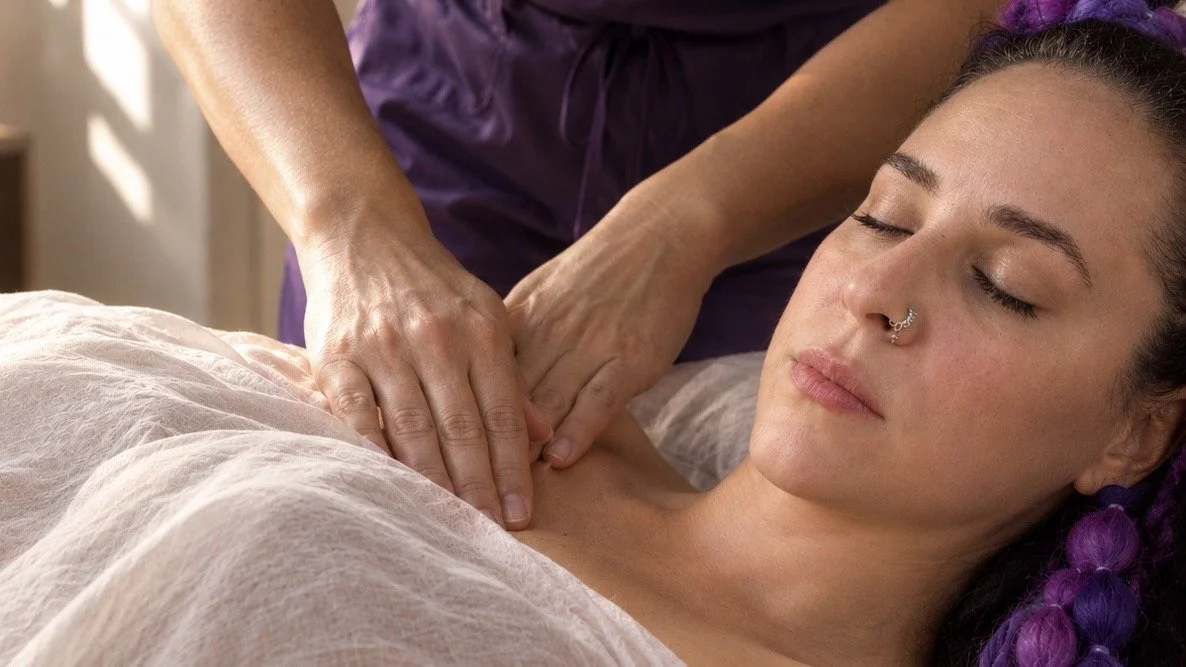
The accompanying image depicts me as the recipient and is intended as an artistic representation of the themes explored in this article, not as a clinical or anatomical illustration.
Clinical References
1. Palumbo RV, Marraccini ME, Weyandt LL, Wilder-Smith O, McGee HA, Liu S, Goodwin MS. Interpersonal autonomic physiology: A systematic review of the literature. Personality and Social Psychology Review. 2017;21(2):99–141. doi:10.1177/1088868316628405.
2. Kleinbub JR, Talia A, Palmieri A. Physiological synchronization in the clinical process: A research primer. Journal of Counseling Psychology. 2020;67(4):420–437. doi:10.1037/cou0000383.
3. Chen WG, Schloesser D, Arensdorf AM, Simmons JM, Cui C, Valentino R, Gnadt JW, Nielsen L, St. Hillaire-Clarke C, Spruance V, Horowitz TS, Vallejo YF, Langevin HM. The emerging science of interoception: Sensing, integrating, interpreting, and regulating signals within the self. Trends in Neurosciences. 2021;44(1):3–16. doi:10.1016/j.tins.2020.10.007.
4. Clark T. The psychotherapeutic relationship in massage therapy. International Journal of Therapeutic Massage & Bodywork. 2019;12(3):22–35. doi:10.3822/ijtmb.v12i3.447.
5. Flückiger C, Del Re AC, Wampold BE, Horvath AO. The alliance in adult psychotherapy: A meta-analytic synthesis. Psychotherapy. 2018;55(4):316–340. doi:10.1037/pst0000172.
6. Neal DP, Nestor BA, Archer C, Molinari Ulate M, Wild MG, Kelley JM. Interventions that strengthen the patient-clinician relationship improve healthcare outcomes: An updated systematic review and meta-analysis. Patient Education and Counseling. 2026;150:109699. doi:10.1016/j.pec.2026.109699.
Previously in the Series
Part One: The Body as a Teacher
Part Two: The Body Begins to Speak
Part Three: When the Body Releases
Part Four: Breath as the Bridge
Part Five: Mapping the Body's Holding Patterns
Coming Next
Part Seven: The Pattern I Did Not Expect to Find
The next part of this study turns inward again, toward a pattern I did not expect to recognize in myself: the tendency to direct my own healing instead of trusting the process enough to let it unfold.